
Shattered windshield
shattered dreams of spring and…
Oh, spring morning frost
Shattered windshield
shattered dreams of spring and…
Oh, spring morning frost
It’s a cliche that has become an oxymoron but is in fact a maxim of compliance. It’s an old lesson, it’s a hard lesson. I learned it long before I became a compliance officer.
One of my life careers, yes there’ve been many, was with the U.S. Navy. The navy believes in inspections, exams, exercises, always testing. There’s a reason for that and it’s because it’s dangerous out there. Especially when there are only a little over a hundred of you racing around the world’s oceans submerged in a small metal tube.
Submarines really only have one mission in life and that’s to make sure the number of surfacings always equals the number of dives. Pretty quickly you learn that all this testing, examining, exercising – not physical although you may sweat the exercise – has one objective, your safety and your ability to fulfill that one mission of submarines. Voila, I’m here, I like examiners.
True, not all examiners are created equal. But you find that everywhere, in every profession, in all walks of life. Maybe I’ve just been unbelievably lucky, I certainly have been in love – different subject, because I’ve very, very, very seldom found that people who try to make your life a living hell last. They’re usually gone the next time I’m there and if they’re not the business won’t be there shortly there after. At least not with the same people running it.
So whenever an examiner, inspector, or someone similar shows up, announced or unannounced, we’re glad to see them. Whether it’s NCUA or the State elevator inspector, or the local fire marshal we’re ready and eager to learn. And apply – that’s one of the keys to having a good working relationship with your examiner and fodder for a future blog.
Remember, they’re your examiner and they’re the only examiner you’ve got.
You’re early! I’m still dressing but will be ready soon. I’ve already put on my disclosure, I’ll add a little bit about myself – you know, who, what, why, all that – and probably change my theme a couple of times along the way. Bear with me while I finish getting ready.
Slumped against the wall
at sunrise waiting, waiting,
winning bingo call.
Youthful tiara crowns
Spring rose’s first blooming buds.
Ah, dew sparkled web.
Yevgeniy Yevtushenko is the poet who inspired and fired my imagination. It wasn’t that I didn’t like poetry, I did and devoured it. All of them came from collections of poetry, and it wasn’t as if I didn’t know poetry didn’t need to rhyme, or that it could swell with emotion. But, the poem Prologue attached itself to me like no other ever has. Funny that I don’t remember exactly where I read it, well I do, I know it was a magazine, one my parents subscribed to, so probably the Saturday Evening Post. They published a volume in 1963 with Yevtushenko on the cover, he also graced the cover of Time the same year, but the Post is most likely where I read it. Here is Prologue (George Reavey, translator):
I’m different,
hard-working,
and idle too;
I have a goal and yet I’m aimless!
I don’t, all of me, fit in; I’m awkward,
shy and rude,
nasty and good-natured.
I love it when sharp edges blur.
Many opposites meet in me:
from west to east,
from envy to delight.
I know you insist on the “compact monolith.”
But it is the opposites that have value!
You need me. I’m heaped as high
as a truck with fresh-mown hay.
I fly through voices, branches, light and warbling,
with butterflies in my eyes, and hay sticking out of cracks.
I greet all that moves! Ardent desire,
and eagerness, triumphant eagerness!
Frontiers are in my way. I am embarrassed
not to know Buenos Aires and New York;
I’d like to walk at will through London streets
and talk with everyone I want, even in broken English.
I’d like to ride through Paris in the morning,
hanging on to the back a bus like a boy.
I want art to be as diverse as myself;
and even if art brings trouble,
and harasses me on every side,
I am already the besieged–besieged by art.
I’ve seen myself in every sort of thing:
I feel close to Yesenin and Walt Whitman,
to Mussorgsky with the whole stage in his embrace,
and Gauguin tracing his virgin line.
I like to skate in winter,
write poems through sleepless nights;
I like to mock an enemy to his face,
and carry a woman across a stream.
I bite into books, and carry firewood;
I can feel depressed, and know vaguely what I seek.
In hottest August I love to crunch
An ice-cool slice of watermelon.
With no thought of death I sing and drink,
fall on the grass with arms outspread’
and if I should die in this wide world,
then I’ll die most happy to have lived.
So what do you think? And does the age at which you read this make a difference?
I never know when I read Prologue now if it is impacting me afresh or is it just calling to memory feelings and emotions, desires and dreams… From all those years ago.
Still love Yevtushenko’s poetry though.
[Yes, I’ll have to write soon about the impact of the translator on a poet’s work. Reavey has translated and written on Yevtushenko extensively and I’ve occasionally read other translations of Prologue and it doesn’t resonant like this version did and does.]
Life has its own meter and rhythm…
composing itself into haiku, and odes
pacing itself, stately and oh so slow,
then childishly ignoring what bodes.
Rushing at times without apology
or angry, weeping, open heart bleeding,
painful moments expressed in eulogy,
changing tempo, closing crescendo.
Life in its own meter and rhythm…

Sunday’s Child, watercolor, private collection, was one of those serendipitous moments on a sketching day in early spring when I was exploring an old mansion and its grounds. There were two formal walled gardens. I turned into one and there was the perfect picture. A moment of life frozen in time.
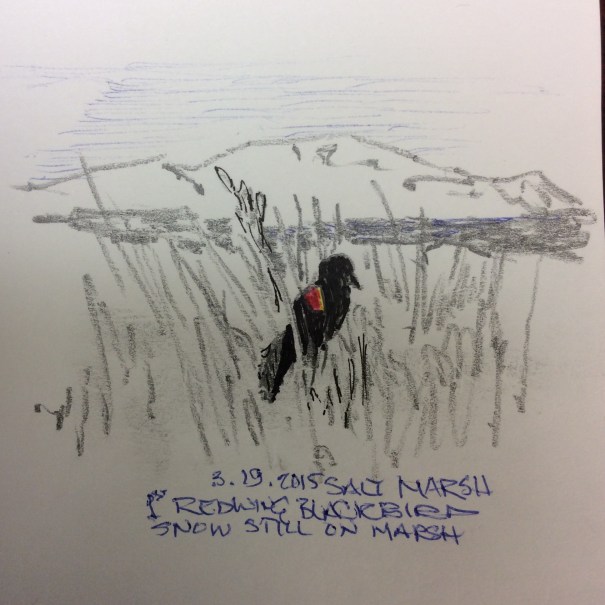
On snowy salt-marsh reed,
a lone redwing blackbird clings;
Sentinel of Spring
Again this morning, yesterday while driving, on waking, in the middle of a meeting… How often do the perfect words form? At the most inappropriate times. Leaving you waking to their evaporating memory.
Do you leave it, swirled into mist, unsharable, only a fleeting memory of what might have been? Or, do we hastily make some notes, never capturing the whole, and later spend hours trying to hammer it back into shape. It still looks like the front end of a ’58 Ford, slightly dented, hammer marked, and badly painted.
‘night embrace…’ is not the poem that formed in the night. It’s only the frustration that replaced that captured, then lost, image.
 Haiku Journey