
Silver flashing streak
Headlights sweeping the meadow.
Coyote in the night
Silver flashing streak
Headlights sweeping the meadow.
Coyote in the night
Spring has sprung a leak!
Winter precipitation,
Thermostat needs a tweak.
Bands of blue and purple,
Signs of winter’s brutal weather,
Have bruised the sky.
Tasting blood red, sweetness,
Seeing blue skin, bruising, crushing,
Grapes into wine.
Secretly I have been
watching you, wanting you to start.
Watching me too.
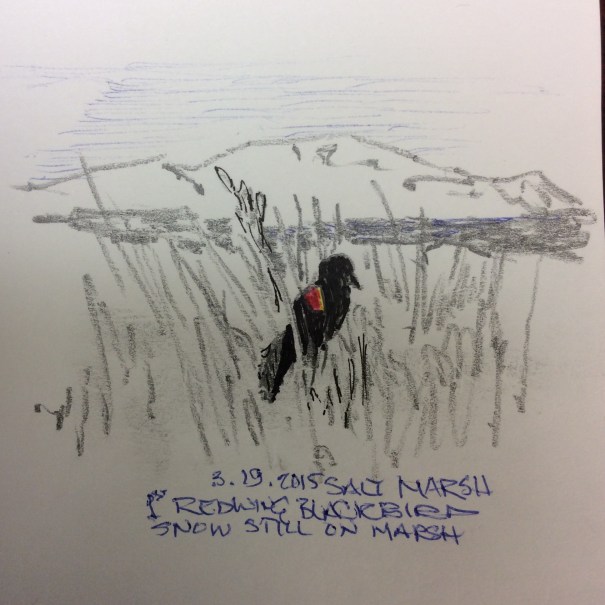
On snowy salt-marsh reed,
a lone redwing blackbird clings;
Sentinel of Spring
Bittersweet life comes
When rhythm and harmony are lost.
In music and love
Waning moon, day star
Aging brother, bright sister
Spring morning wonder
Virgin, pristine snow –
so white, glistening in sun’s glow,
dammed ice. Damn!
Matsuo Basho (1644 – 1694) wrote this Haiku after he entered Koyasan monastery in about 1666. Poetry had been a leisure activity of the Samurai class and Basho had begun writing at an early age and continued to study and develop his art. He is today considered one of the major forces in the development and shaping of Haiku. So the challenge is to shape your own Haiku using the same Japanese words that inspired Basho:
   かれえだ に からす の とまり けり あきのくれ
   kareeda ni / karasu no tomari keri / akinokure
   On withered branch, was crow's resting, autumn ending
My interpretation, or translation, of this would be:
          A withered branch,
                  at a crow's alighting,
               nearly winter.
The Japanese for this is: Kareeda (withered, withered branch) ni (position/location) karasu (crow/raven) no (possessive) tomari (stop, end) keri (poetic past tense, recollection) akinokure (autumn dusk, end of autumn) – note that there is not punctuation to help define this and the kanji is the modern. Basho’s kanji would have been evenly spaced out and the reader would be expected to know the intended meaning. And, ‘keri’ can either be an indicator of past tense or poetic emphasis.
So, have fun. Play with it. Leave your haiku in a comment, as many as you like. Thanks for playing.
 Haiku Journey